
Yucca Schidigera Extract: Saponins and Application Grades
Updated: Aug 13
Yucca schidigera extracts are used across animal nutrition, beverage processing, cosmetics and agricultural applications. Commercial products may be sold as powders, liquids or concentrated extracts and described by saponin percentage. The headline assay is useful only when the analytical method and application performance are understood.
For procurement teams, the central question is not “30% or 60%?” It is which grade delivers the required dispersion, handling, dose and performance in the customer’s system.
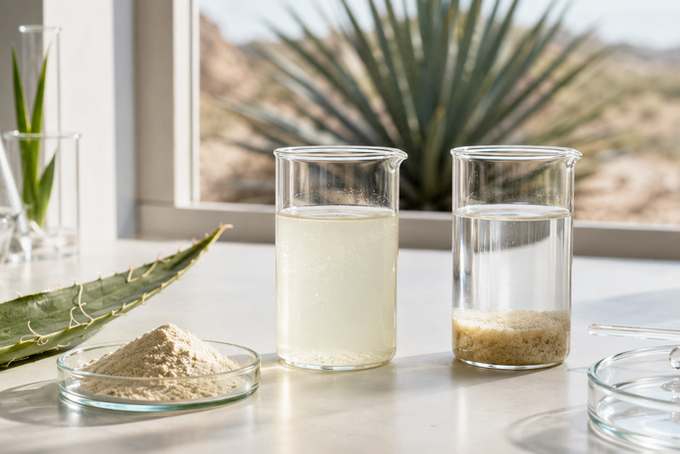
Yucca grades should be compared using method, composition and application testing.
1. Define the application first
Application | Important properties | Typical evaluation
Application: Animal feed • Important properties: Assay, carrier, particle size, premix distribution and palatability • Typical evaluation: Feed compatibility and inclusion-rate trial
Application: Soil or agriculture • Important properties: Dispersibility, foaming, compatibility and dose economics • Typical evaluation: Jar test followed by field or nursery trial
Application: Beverage or food processing • Important properties: Purity, permitted use, sensory profile and microbiology • Typical evaluation: Regulatory review and matrix testing
Application: Cosmetic systems • Important properties: INCI, composition, colour, odour and preservation • Typical evaluation: Formulation stability and safety review
2. Saponin percentage is method-dependent
Yucca contains a complex mixture of steroidal saponins. Different suppliers may use spectrophotometric, gravimetric, HPLC or other internal methods that do not produce directly comparable numbers. Published reviews note that LC-MS is widely used for characterisation, while routine commercial quantification still needs careful method definition.
Ask for the method principle, reference standard, calculation basis and repeatability. A 60% result from one method may not be equivalent to 60% from another.
3. Higher assay is not always lower cost-in-use
A concentrated grade can reduce freight and inclusion volume, but it may be more hygroscopic, foamy or difficult to disperse. A lower-assay grade with a suitable carrier may distribute more evenly and perform better in the actual process. Compare delivered performance at the target dose.
4. Solubility and dispersibility are different
Some yucca powders disperse in water without forming a true clear solution. For soil drenches or liquid systems, evaluate sediment, foam, mixing time, nozzle compatibility and stability after dilution. A supplier’s statement of “water soluble” should be confirmed in the customer’s water quality and pH.
5. Compatibility requires bench testing
When yucca is combined with humic substances, minerals, microbial inoculants or surfactants, check pH, precipitation, foam and microbial viability. Mix order and concentration can change the result. Avoid assuming that compatibility in one concentrate will transfer to another.
6. Request a complete quality package
Botanical identity and used plant material
Manufacturing and extraction flow
Full composition and carrier percentage
Saponin method and representative chromatographic information
Moisture, particle size and bulk density
Microbiology, heavy metals, pesticides and relevant feed or food controls
Packaging, shelf life and storage conditions
7. Build a two-grade trial
When freight is a major sample cost, it can be efficient to compare two grades in the same trial—for example a moderate assay and a higher concentrate. Use equal saponin-equivalent doses as well as equal product-weight doses to separate concentration from formulation performance.
Buyer checklist
Define application, delivery system and target dose.
Confirm the saponin method before comparing percentages.
Review full composition and carrier.
Test dispersibility, foam and compatibility.
Compare cost-in-use rather than price per kilogram.
Approve the grade only after application testing.
Related Herbify guides
How Herbify can help
Herbify supports Australian and New Zealand product developers, contract manufacturers and brands with botanical extract sourcing, specification matching, samples, technical documentation and custom-format discussions.
Regulatory note: ingredient suitability, permitted claims and labelling depend on the final product category, dose, formulation and market. This article provides general commercial information and is not medical, legal or regulatory advice.


Comments